

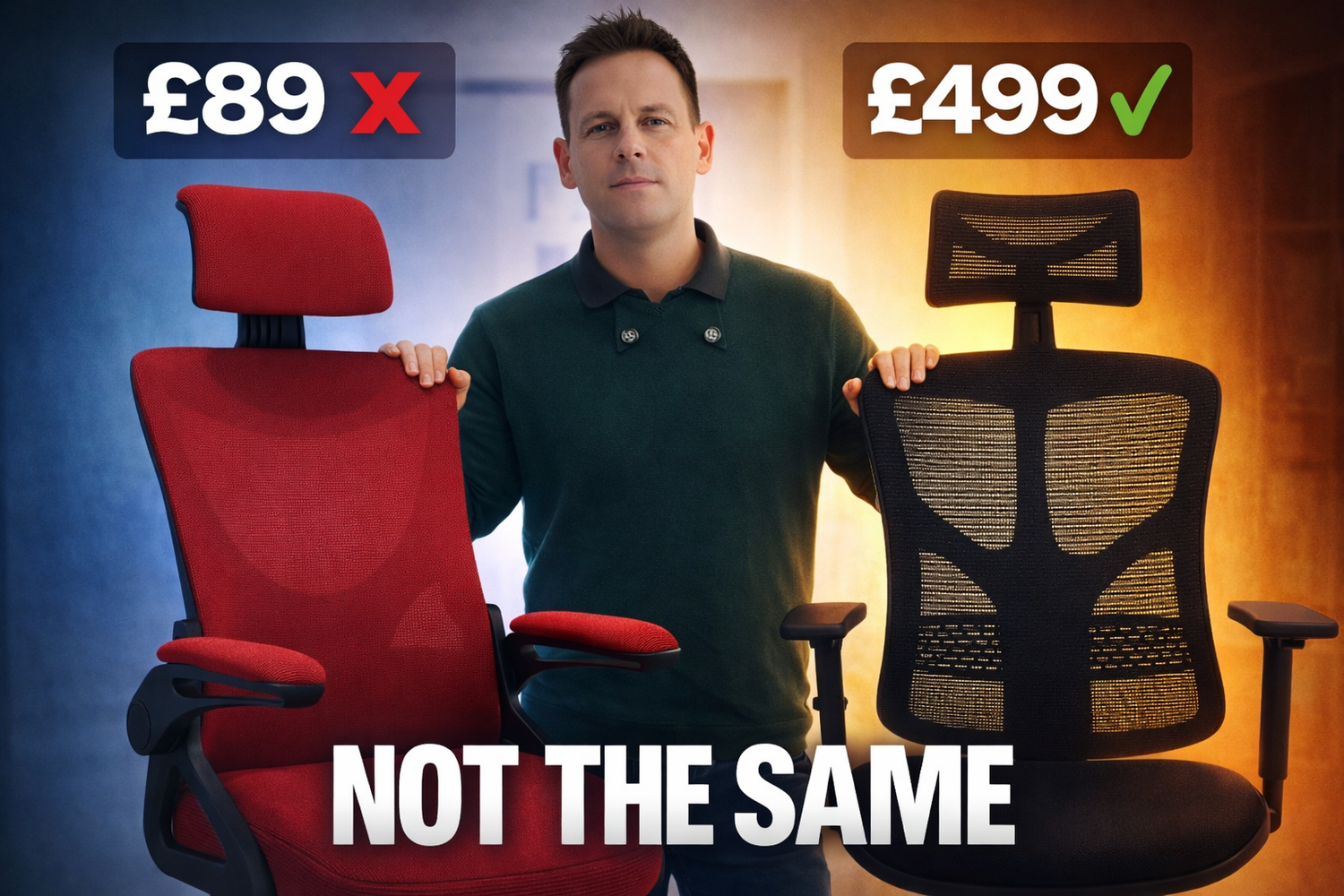
£89 vs £499 Office Chair: Why Cheap “Eronomic” Chairs Fail
On the surface, these two office chairs might look fairly similar.
One costs just under £100. The other costs just under £500. Both are sold as “ergonomic” office chairs. Both have a mesh back. Both have armrests. Both have a headrest. So it is easy to assume they are basically doing the same job.
But as a chiropractor, I can tell you there is a big difference between a cheap chair that looks ergonomic and a genuinely adjustable ergonomic chair that is designed to support you properly through the working day.
In this video, we compare an £89 Amazon-style office chair with The Catalyst chair from Well Adjusted Seating to show where that extra money actually goes — and why it can matter so much if you sit for long periods or struggle with low back pain.
Why Cheap Chairs Can Look More Ergonomic Than They Really Are
This is where many people get caught out.
A chair can look ergonomic without actually being very ergonomic in use.
Many cheaper office chairs now copy the visual style of higher quality ergonomic chairs. They may have a mesh back, a headrest, a lumbar support pad and armrests. On a product photo, that can look convincing.
But the real test is not how ergonomic a chair looks. The real test is whether it can adapt to your body.
That is where the difference starts to show.
First Impressions: Weight, Build Quality and Materials
The cheaper chair weighs around 13kg. It is light, easy to move and feels relatively flimsy when you handle it.
The higher quality chair weighs closer to 23–24kg. Straight away, you can feel the difference in the frame, mechanism and materials.
That extra weight is not just for the sake of it. It usually reflects stronger components, a more substantial mechanism and a more robust overall build.
What you notice on the cheaper chair
- Thinner plastic parts
- More flex through the back frame
- A lighter, less stable feel
- Basic foam that compresses quickly
- A seat base that feels firm underneath the padding
What you notice on the better chair
- A heavier and more stable frame
- Less unwanted movement through the chair
- A more supportive seat shape
- Better quality controls and mechanisms
- A more planted feel when you sit and recline
This matters because an office chair is not just a visual product. It is something you may sit in for 4, 6 or even 8 hours a day.
Adjustability Is Where The Real Difference Shows
If a chair is going to be called ergonomic, it needs to be able to adjust to different users.
We are not all the same height. We do not all have the same leg length, arm length, torso length or sitting posture. A good chair needs to be able to adapt to those differences.
The cheaper chair has limited adjustment
The cheaper Amazon-style chair has some adjustable features, but they are very limited.
- Basic height adjustment
- Armrests that only move up and down
- A small lumbar support pad that slides up and down
- A headrest that moves up and down
That might sound like enough on paper, but in practice it leaves several problems.
The backrest height is fixed. The seat depth is fixed. The armrests cannot move forwards, backwards, inwards or outwards. The lumbar support is quite flimsy. The mesh does not provide enough structure when you lean back into it.
That means the chair may look adjustable, but it may still fail to fit your body properly.
The better chair offers much more control
On a higher quality ergonomic chair, the adjustments are more useful because they help you fine-tune the chair to your body.
- Seat height adjustment
- Seat slide adjustment
- Adjustable backrest height
- Adjustable lumbar support
- Synchronous movement mechanism
- Multi-position recline lock
- Three-dimensional armrests
- Adjustable headrest
The seat slide is especially important. It allows you to move the seat forwards or backwards so your legs are properly supported without too much pressure behind the knees.
The adjustable backrest height also makes a big difference because it allows the lumbar support to sit in the correct place for your spine, rather than forcing your back to fit a fixed chair shape.
The Lumbar Support Problem
This is one of the biggest differences between the two chairs.
On the cheaper chair, the lumbar support can move up and down, which initially seems useful. But when you lean back into the chair, the mesh does not provide enough structure. Instead of feeling evenly supported, you may start to feel the frame or hard parts of the chair pressing into your back.
That is not proper lumbar support.
On the better chair, the backrest and lumbar support work together. The mesh supports the back more evenly, and the frame sits away from the spine rather than digging into it.
This is the difference between a feature that exists on a product listing and a feature that actually works when you sit in the chair.
Why Armrests Matter More Than People Think
Armrests are often overlooked, but they can have a big effect on your posture.
On the cheaper chair, the armrests only move up and down. If they do not line up properly with your desk or body, you have limited options. They may hit the desk, force your shoulders into an awkward position, or need to be moved out of the way completely.
On the better chair, the armrests are much more adaptable. They can move:
- Up and down
- Forwards and backwards
- Inwards and outwards
- At an angle for typing and desk work
This allows your elbows and shoulders to be supported without forcing you into a hunched or compressed position.
Comfort: The Difference After A Few Hours
Comfort is not just about how a chair feels in the first five minutes.
A chair can feel acceptable when you first sit down, but start to fail after 30 minutes, an hour or a full working day.
With the cheaper chair, the foam may feel padded at first, but it often lacks consistency and support. After a while, you may start to sink into the back of the seat. The chair can begin to feel more right-angled and less supportive than it looked in the photos.
That can encourage you to slide forwards, flatten your lower back and slouch into the chair.
On the better chair, the comfort comes from a combination of better materials, a more supportive seat shape and more useful adjustability. The chair supports you without making you constantly aware of it.
That is what a good office chair should do. It should feel like it has got you.
Is The Extra £400 Worth It?
This depends on how you use the chair.
If you only sit for one or two hours occasionally, or you need a chair for occasional homework, emails or a family computer, a cheaper chair may be enough.
But if you sit for 4–8 hours a day, several days a week, the difference becomes much more important.
At that point, you are not just buying a chair. You are investing in something that supports your back, your posture and your working day.
A better chair becomes more important if:
- You work from home regularly
- You sit for several hours per day
- You already have low back pain
- You fidget constantly in your current chair
- You feel stiff when you stand up
- Your current chair feels uncomfortable after an hour or two
If you already struggle with back pain, a better chair may also help reduce the need for repeated chiropractic or physio visits by improving the support you get during the working day.
The Hidden Cost Of Cheap Furniture
There is also another important point: waste.
When you buy cheap, you often buy twice.
A cheaper chair may last one, two or three years if you are lucky. A good quality ergonomic chair can last much longer — potentially 10 to 15 years depending on use and care.
That matters for your bank balance, but it also matters environmentally.
We do not need more cheap plastic office chairs being thrown away after a short period of use. Investing in a better chair can be a better long-term decision for your body, your wallet and the planet.
Chiropractor’s Verdict
The £89 chair is not automatically a terrible chair. For light, occasional use, it may be perfectly adequate.
But if you are working from home regularly, sitting for long hours or already struggling with low back pain, the limitations become much more obvious.
The real difference between these two chairs is not just the price.
It is the build quality, adjustability, support, comfort and longevity.
A chair that looks ergonomic is not always the same as a chair that properly supports you.
Final Thoughts
Before buying your next office chair, do not just look at the product photo or the word “ergonomic”.
Look at what the chair actually allows you to adjust.
Can the backrest move? Can the seat depth change? Can the armrests properly support your working position? Does the chair feel stable? Will the materials last?
Those are the details that make the biggest difference once you are sitting in the chair for hours at a time.
Need help choosing the right ergonomic chair?
At Well Adjusted Seating, we specialise in chiropractor-led ergonomic seating advice for home offices and workplaces.
You can explore our chair range, book a consultation, or visit Sit School™ for more practical desk setup advice.



Leave a comment
This site is protected by hCaptcha and the hCaptcha Privacy Policy and Terms of Service apply.