

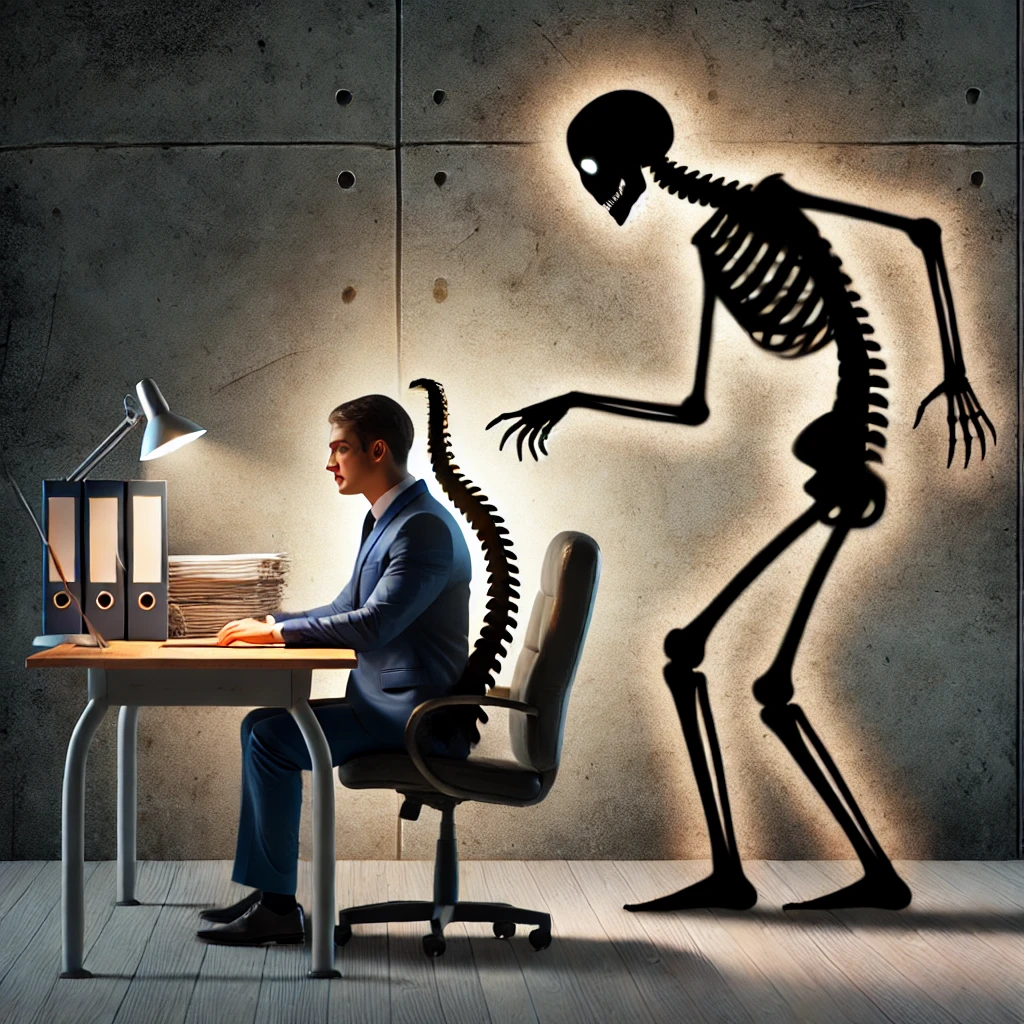
Don’t worry about your posture, watch out for the creep in the room!
One of the things we’re constantly being nagged about when it comes to office seating is your posture.
As a chiropractor writing this, I’ve lost count of the number of times I’ve heard this being said from my patients when it comes to their reasoning as to why they have sore necks and backs from their office job. They’ll say “I know I’ve got bad posture, and we’re told, don’t slouch, don’t cross your legs and I should sit up straight”. This is all linked to that word posture which you’ve come to learn is the holy grail. But ironically in the world of Physiotherapists, Chiropractors or Osteopaths this is actually a dirty word. Yucky.
In short, a good posture is a changing posture! One which involves fidgeting, slouching, straightening, flexing, bending and even getting your legs up on the desk (now and again).
All these are descriptions of movement, movement is the key to feeling better with so many muscular skeletal issues. Most patients of mine see some of the above movements as a negative and they should remain in a rigid state all day while working at their desk, like a game of musical statues without the music ever coming back on.
Like a well-oiled machine we need to be moving. That sounds slightly ridiculous when the main aim of working at a desk with a chair is to be sat. But that’s what we like to bang the drum about constantly at WellAdjusted seating. The two ways we can achieve this is regular breaks from our workstation, every 45 minutes and also using our chair to help achieve micro movements through the day. Our slow twitch muscles need this to keep our spine from becoming compressed by gravity. If we don’t do this then we become one moving part rather than 33 individual parts. When these vertebrae become stuck in one position that’s when we become creeps!
Yes, you heard that right. Creep is an orthopaedic term to describe a gradual deformation of the spine over time when a constant load is applied. The viscoelastic property of bone that can contribute to permanent spinal changes. Now some of that was technical talk, so I’ll break it down:
Deformation: a change in the quality and structure of the vertebrae. This could include signs of osteo arthritis, ligament weakening and thickening and reduced nerve activity.
Viscoelastic: viscous and elastic tissues in the spine. This would be the discs of the spine. The discs are there to act as shock absorbers and keep a nice space between our vertebrae.
The effect of creep can be most commonly seen when we sit for too long. This is due to gravity and a lack of movement putting pressure on our joints and discs in the spine. This can affect the surrounding joints including our pelvis and hips. This is because the passive tissues (ones which we have stopped using in that position) are continually loaded.
So, to counteract this that’s why we have to move. It’s never too late and even in the oldest and most beaten-up spines that we see, we always find “motion is lotion”.
So, in summary your actions to counteract this are:
- Get and move regularly (every 45 minutes)
- Fidget, bend and stretch and even slouch in your chair
- Buy a chair with as many functional movements as possible
- Then learn how to use these functional movements your chair can do – no point in just having them without knowing how to
- Exercise away from your desk – it’s so important for your back and wider health.



Leave a comment
This site is protected by hCaptcha and the hCaptcha Privacy Policy and Terms of Service apply.